Built for the EU AI Act, US state AI laws, GDPR, and CCPA
Defensible to your regulator, your auditor, and your compliance team.
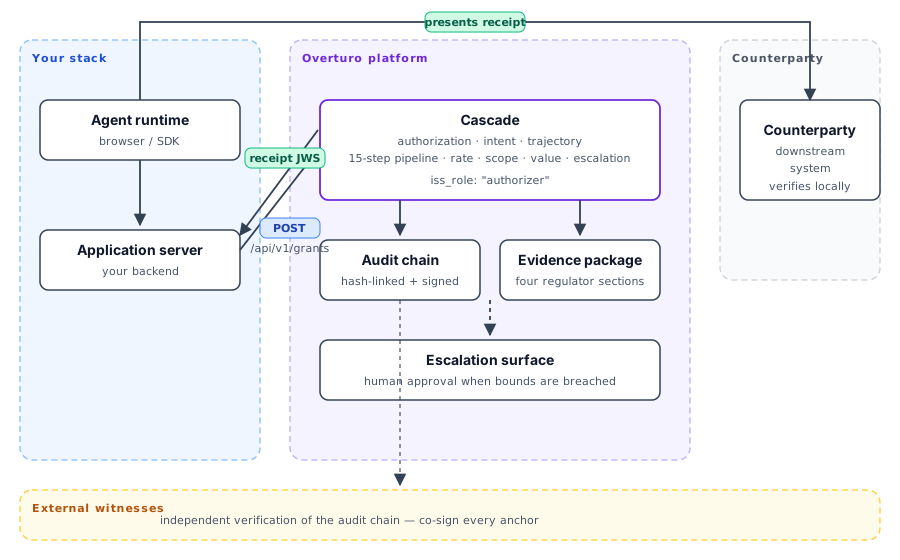
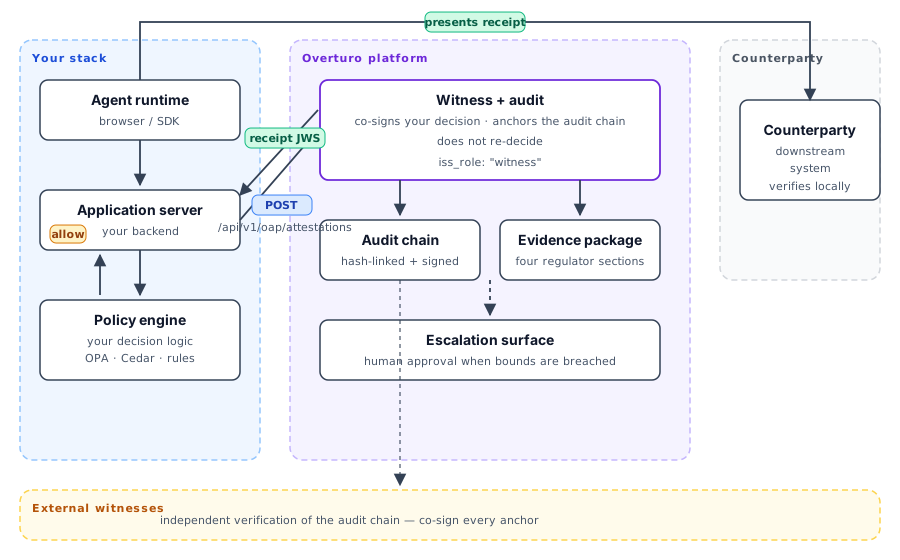
Every Oversight decision arrives carrying a declared legal basis. The platform stitches them into an evidence package keyed to the EU AI Act and GDPR — deterministically serialised, hashed, and signed end to end. Compliance officers receive a single artefact they can hand to an auditor without an engineer in the room.
AI agents that affect access to services, employment, or financial obligations typically fall under the EU AI Act’s high-risk AI system classification (Annex III) — and under parallel US frameworks: Colorado AI Act consequential decisions (effective February 2026), NYC Local Law 144 automated employment decision tools, California ADMT regulations under CPRA, and the NIST AI Risk Management Framework’s high-risk decision categories. OAP delivers the underlying obligations — record-keeping, human oversight, and quality-management logging — as platform behaviour rather than custom engineering, regardless of which framework you’re evaluated under.
The evidence package
One bundle per reporting window. Four sections, each keyed to a specific regulatory citation so a reviewer can navigate directly to the article they’re evaluating. The bundle is canonicalised, SHA-256 hashed, and Ed25519-signed by the platform — verifiable independently against the published JWKS.
GDPR Article 30 — Records of Processing
The complete log of categories of processing, legal bases invoked, recipients, and retention periods that GDPR Article 30 obliges a controller to maintain.
EU AI Act Article 14 — Human oversight
Evidence that human-in-the-loop review was offered and exercised. Each escalation, approval, denial, and counter-proposal is captured with the principal’s identity and decision.
EU AI Act Article 17 — Logging
The full timeline of decisions made by your AI system, with cryptographic integrity guarantees so the regulator can trust the log itself.
GDPR Article 22 — Automated decisions
Per-decision marker for solely-automated processing plus a principal-side pathway to invoke human review under Article 22(3).
Legal basis is wire-level, not optional
Every attestation carries one of the six GDPR Article 6 lawful bases. The set is closed at the API boundary — an attestation missing a valid legal_basis is rejected before it’s ever recorded. There’s no untagged decision to explain away later.
legal_obligationArt. 6(1)(c)
vital_interestsArt. 6(1)(d)
legitimate_interestsArt. 6(1)(f)
The Oversight operator dashboard rolls a 30-day histogram of legal-basis usage per agent class. When legitimate_interests exceeds 95% of decisions, a Legitimate Interests Assessment prompt surfaces automatically — we treat over-reliance as a compliance signal worth flagging.
The principal’s own grant view at /oap/grants/:id carries the legal basis, signed receipt, and audit-chain anchor for every action, with CSV and JSON export.
DSAR & ROPA
Data Subject Access Requests run through a dedicated pipeline with the statutory 30-day deadline tracked from receipt. Reminder jobs fire at 14 days and 7 days remaining so the deadline doesn’t slip. Records of Processing Activities are generated on demand and exported in a regulator-ready format.
Compliance blocks shipping today
For US deployments, the platform ships CCPA, BIPA (Illinois biometric data), and COPPA building blocks today; the SOC 2 starter provides controls scaffolding. Additional legal-basis configurations cover LGPD (Brazil), POPIA (South Africa), and PDPA (Singapore). Implementation guides for the NIST AI Risk Management Framework and ISO/IEC 42001 are in the developer documentation.
In development: sectoral packs for HIPAA, PCI-DSS, FINRA, FedRAMP, NIS2, and DORA. Talk to us about your specific regulatory footprint.
Configurable retention. Evidence packages and chain records are kept for a per-application window between 1 and 3650 days. The default is 365. Your compliance team sets the value once; the platform enforces it.